Deep and Vast. Toyama Bay as a Natural Fixed Net
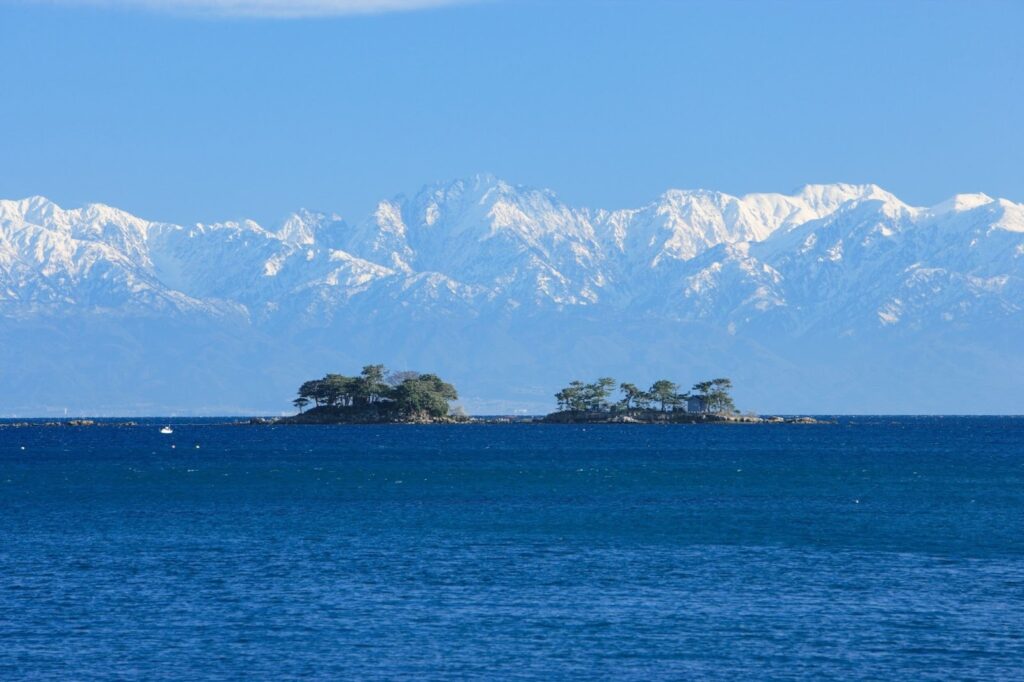
Toyama Bay Itself Is a Natural Fixed Net
When talking about Toyama’s sushi culture, the bay’s unique geography is impossible to ignore.
The Sea of Japan, including Toyama Bay, did not exist until about 25 million years ago. At that time, the Japanese archipelago was still part of the Eurasian continent. As tectonic movements pulled the landmass eastward, the Sea of Japan was formed around 15 million years ago.
Later, from about 3 million years ago, changes in plate movement caused the land to rise, shaping the Noto Peninsula, Sado Island, and Toyama Bay as we know them today.
Toyama Bay opens to the northeast, facing Sado Island. Between Sado Island and the Noto Peninsula, deep submarine canyons extend remarkably close to the coast. These canyons, reaching depths of more than 1,000 meters, or about 3,280 feet, are another result of the complex geological processes that formed the Japanese archipelago.
This geography naturally draws fish into the bay. Large migratory species such as yellowtail, tuna, and marlin, along with smaller fish like horse mackerel and sardines, are guided deep into the bay.
As Japan itself was formed, Toyama Bay became a landscape that welcomes fish. In that sense, it functions as a natural fixed net, supporting Toyama’s rich fishing and sushi culture.
Three Layers of Water and Seafloor Springs That Sustain Toyama Bay
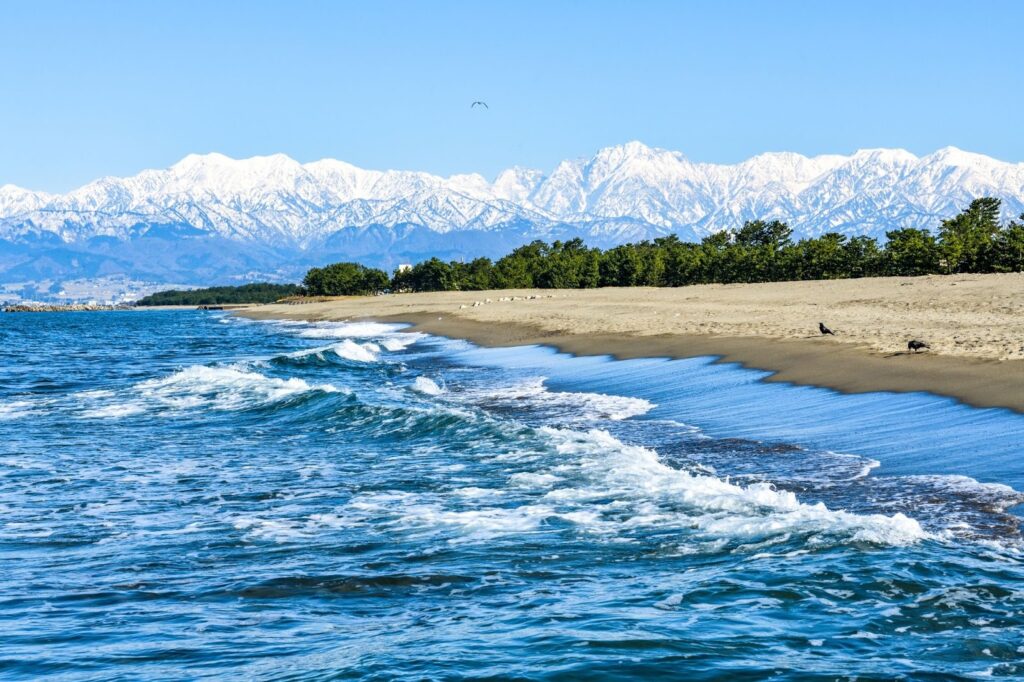
Toyama Bay’s abundance is shaped by more than its geography. Its water structure is equally distinctive.
The Tsushima Warm Current flows into the bay from the southwest after rounding the Noto Peninsula. Near the coast, this warm seawater mixes with river water flowing from the Tateyama mountain range and with freshwater that springs up along the shoreline. Together, they form a unique surface layer known as Toyama Bay Shallow Water. The rivers from Tateyama also carry nutrients from the forests into the sea.
Below this, at depths greater than 300 meters, or about 980 feet, lies cold, dense, nutrient rich water known as Japan Sea Proper Water, cooled by Siberian air masses. This deep layer is home to species such as large ivory shells, snow crab, red snow crab, northern pink shrimp, and the deep sea fish known locally as noro genge.
Because of its complex seabed and overlapping water layers, Toyama Bay supports an extraordinary range of marine life. About 500 species of fish and shellfish have been identified here, compared with about 800 species across the entire Sea of Japan.
These diverse fishing grounds exist close to shore, allowing coastal fishing communities to flourish throughout Toyama. Alongside them, a distinctive food culture, including Toyama’s sushi, has continued to develop.
Photo courtesy of Toyama Tourism Organization
SHARE to SNS