Toyama Bay Sushi
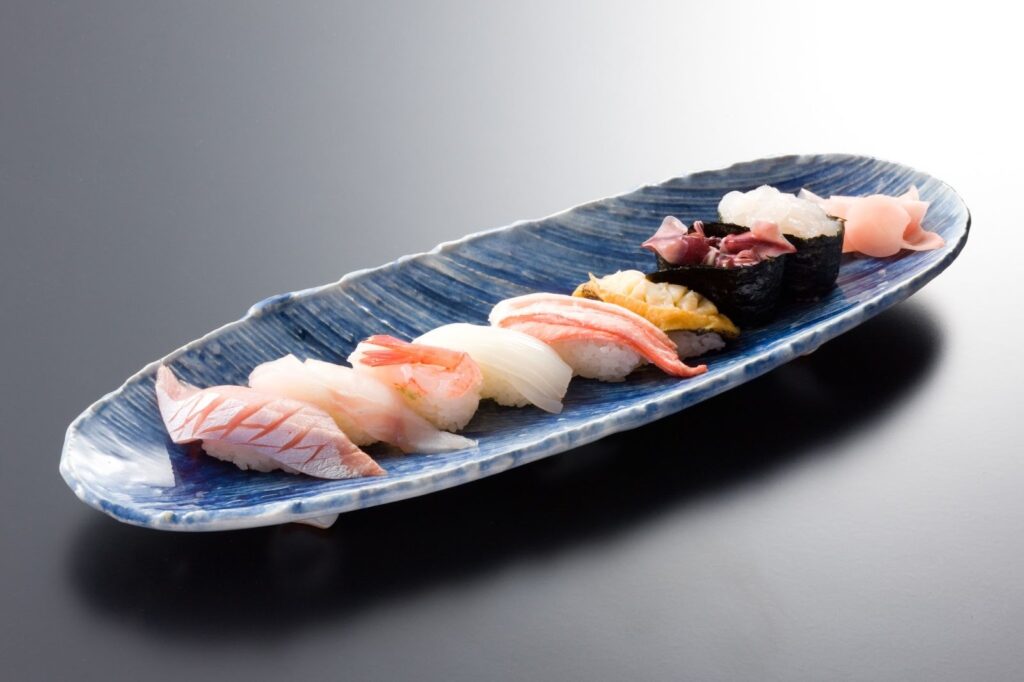

Toyama Bay sushi is shaped by the hands of skilled chefs, who apply their craft to fish with ample room for preparation, making precise decisions at the optimal moment.
Toyama Bay sushi is a style of nigiri sushi that combines the hand-pressed techniques born in Edo (present-day Tokyo) with seafood from Toyama Bay and rice grown in Toyama, one of Japan’s leading rice-producing regions.
Nigiri sushi originated in Edo during the Edo period (1603–1868) and spread throughout Japan, evolving through techniques of preparation, slicing, and hand-pressing applied to seafood.
When these techniques were introduced to Toyama after World War II, local sushi chefs developed a distinctive nigiri culture by taking advantage of Toyama’s unique geography, where fishing grounds rich in seafood lie close to the ports.
Toyama Bay deepens sharply just offshore, placing fishing grounds extremely close to coastal ports. Seafood caught in these waters is chilled onboard using seawater ice and transported back to port. As a result, many fish are landed in a condition close to nojime—neither fully alive nor yet in rigor mortis.
In other words, many fish arrive at the very threshold where umami begins to emerge. For Toyama’s chefs, this represents a rare advantage: fish that offer an unusually wide range of culinary choices.
Whether to immediately dispatch the fish or not, whether to serve it at once or allow it to rest, these decisions are left to the chef. Each skilled artisan makes the optimal judgment, applying skill and experience to fish that offer generous room for interpretation, and then hand-presses the sushi using Toyama-grown rice and vinegared rice seasoned with each restaurant’s own proprietary blend.
Toyama Bay Sushi is born at the intersection of natural abundance and human judgment, where the gifts of the sea meet and the hands of skilled artisans.
Photo courtesy of Toyama Tourism Organization
SHARE to SNS